New Delhi [India], January 9: India has the first human spaceflight programme called the Gaganyaan Mission. Its objective is precise. Introduce Indian astronauts into the low Earth orbit of approximately 400 kilometres. Have three days with them. Return them to the safety of the Indian sea.
No shortcuts. No borrowed rockets. No shared flags.
It has been made clear by the ISRO Chairman, S Somanath. This mission is concerning the ability to show. In case successful, India is a member of an exclusive club. This has not been done previously except by the Soviet Union, the United States, and China.
This is not symbolism. This is systems engineering.
Why 2026 Matters
In line with ISRO, the first human-crewed Gaganyaan launch is expected to take place by the end of 2026.
Prior to that, three uncrewed missions should be successful. No exceptions.
The initial uncrewed flight will take place at the beginning of next year. It was supposed to be held in December but was rescheduled due to technical issues. That delay is not a setback. It is discipline.
There is no optimism in human spaceflight.
The Rocket Is Ready. The Tests Come First
ISRO has ensured that the launch vehicle is prepared. That is not marketing language. It is an indication that the underlying hardware has been developed, assembled, and is in testing.
The only thing left is to demonstrate reliability during several test missions.
Three uncrewed launch flights will precede the astronauts. Rehearsal is not part of these missions. They are gatekeepers.
When the three are successful, the green light for the human mission can be given.
Vyommitra Goes First
Vyommitra will be in the first uncrewed mission.
Vyommitra is not a mascot. It is a humanoid robot that is aimed at imitating the human situation in space. It will control module parameters, environmental controls and mission sequences.
If Vyammitra fails, the astronauts wait.
That is how serious this is.
Astronauts Are Named. Training Is On
India has already given names to their astronaut-designates.
Group Captains Prasanth Balakrishnan Nair, Angad Pratap, Ajit Krishnan and Wing Commander Shubhanshu Shukla are the ones.
The names are not ritual names. They are actively involved in mission preparedness.
Training is ongoing. Familiarisation of the systems, simulation of missions, and emergency procedures. The low churn that seldom breaks the news.
It is there that spaceflight is won in reality.
July 2025 Propulsion Milestone in the Gaganyaan Mission
ISRO made a silent breakthrough on July 3, 2025.
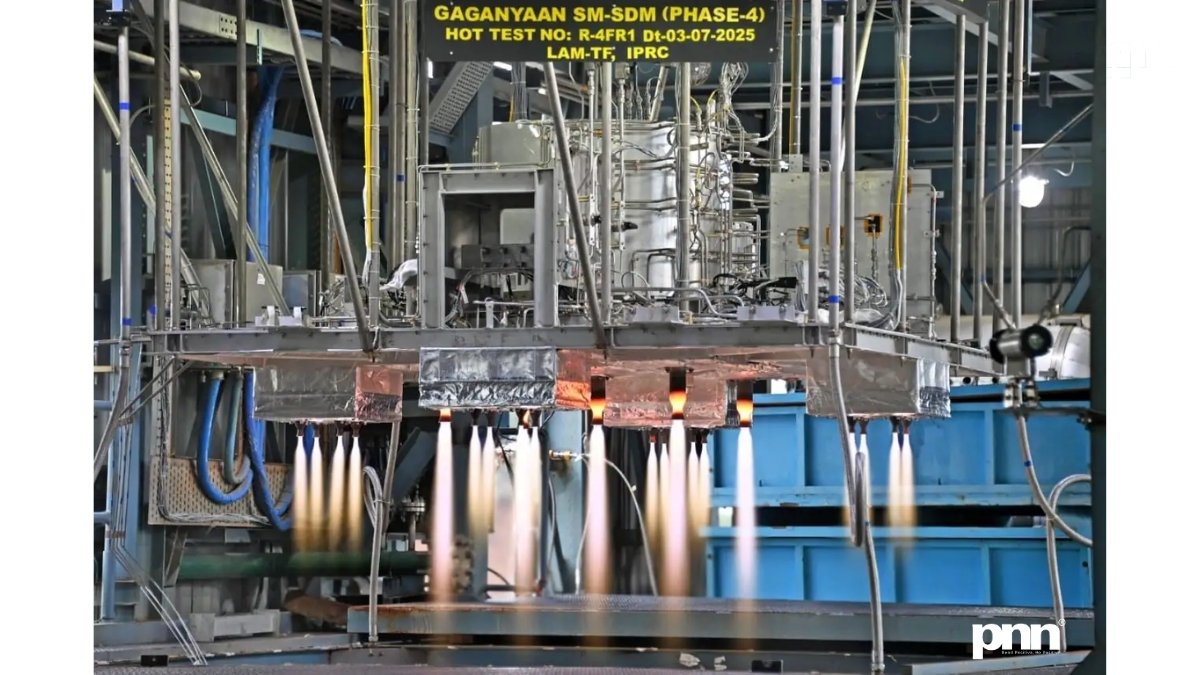
Gaganyaan Service Module Propulsion System Two hot tests of the Gaganyaan Service Module Propulsion System were successfully made at the ISRO Propulsion Complex in Mahendragiri.
One test ran for 30 seconds. The other for 100 seconds.
The findings were in line with pre test predictions.
This is important since the SMPS is an essential system. It deals with orbital manoeuvring and abort situations. Abort systems are not supplementary in human spaceflight. They are lifelines.
The system has five Liquid Apogee Motor engines, each generating 440 Newtons of thrust and sixteen Reaction Control System thrusters, each generating 100 Newtons.
In the extended test, ISRO has demonstrated that all thrusters and engines can operate in different modes simultaneously. Steady. Pulsed. Coordinated.
This is not progressive improvement. This is validation of confidence.
These findings have paved the way for a full-duration hot test followed by ISRO.
What is Different in The Gaganyaan Mission
The Gaganyaan Mission is not in the chase for headlines.
It is being constructed on conservative design margins, multi-redundancy, and incremental validation. That approach is slower. It is also a way of not attending funerals.
India is not racing anyone. It is credibility in engineering.
The approximate programme cost is approximately 90 billion. By the standards of human spaceflight around the world, that is small.
This is not cost efficiency in terms of corner-cutting. It concerns indigenous systems, in-house testing and institutional learning.
Cost, Capability and Credibility
If Gaganyaan is successful, India will be the fourth country to independently launch humans into space.
That changes perception.
It enhances India’s position in international space cooperation. It promotes strategic independence. It confirms the decades of popular investment in science and engineering.
More to the point, it instils internal confidence.
Large countries do difficult things when they feel they can.
Chandrayaan 4 and the Bigger ISRO Play
As Gaganyaan heads toward human spaceflight, ISRO is already strategising its next lunar leap.
The Chandrayaan 4 is approved by the government. The mission is bound to touch down near the south pole of the Moon once again. In this case, the objective is sample return.
That requires two launches. Space docking. Sample recovery. Earth returns.
ISRO has made the challenge. No individual rocket is currently available that can accommodate the required mass. The answer to this is orbital assembly.
This is not a mission undertaken by every country.
ISRO intends to try.
Everything about institutional ambition should be told by that.
What Gaganyaan Mission Means for India
The Gaganyaan Mission is not a high-profile project. It is a futuristic infrastructure.
The deep capability of human spaceflight is established in the fields of materials science, propulsion, avionics, life support, and systems integration. These applications are transferred to defence, aviation, medicine, and manufacturing.
In such a way, countries ascend the ladder of technology.
Quietly. Relentlessly.
ISRO hot tests Gaganyaan Service Module Propulsion System
https://www.isro.gov.in/Successful_hot_tests_Gaganyaan_SMPS.html
PNN news